Science is one of the most important ways humans understand the world around them. From observing the stars and studying the human body to developing computer technology and investigating climate change, science helps us ask better questions, test ideas, understand evidence, and explain how things work.
Today, the word science covers a huge range of subjects, including data science, computer science, environmental science, political science, forensic science, health science, earth science, psychology, and the physical and biological sciences. It also plays an important role in education, research, medicine, technology, business, and everyday decision-making.
This guide explains what science means, how scientific inquiry works, the major branches of science, popular science experiments, science education, career options, and some of the questions people commonly search for online.
What Is Science?
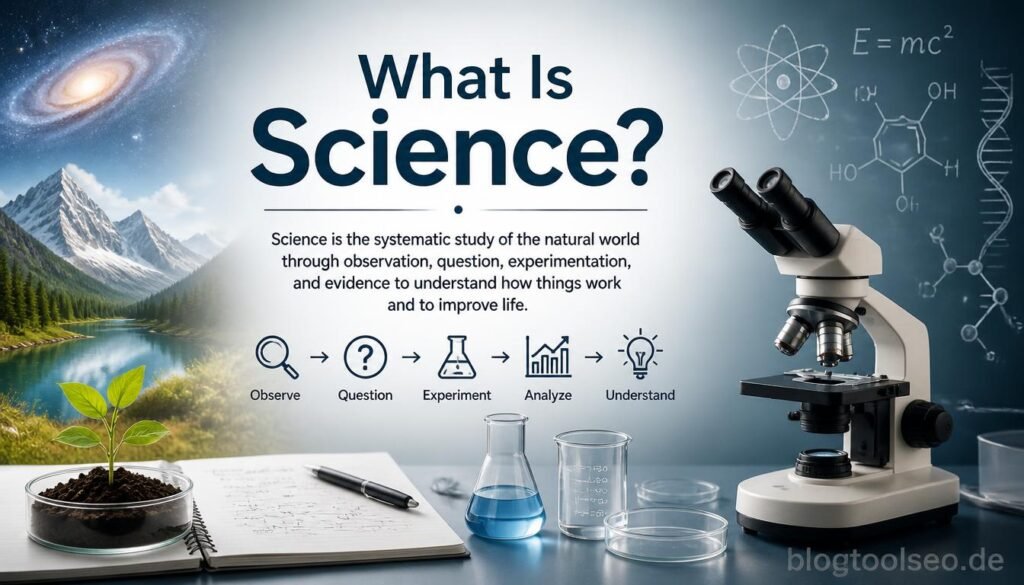
Science is a systematic way of developing knowledge about the natural and physical world through observation, evidence, investigation, testing, analysis, and explanation.
Rather than simply accepting an idea because it sounds convincing, scientific inquiry asks whether evidence supports it. Researchers may make observations, develop questions, collect data, perform experiments, analyze results, and communicate their conclusions.
The National Academies describes science education as involving practices such as asking questions, planning investigations, analyzing data, constructing explanations, and communicating information.
This is why science is more than a collection of facts. It is also a way of thinking.
How Does Science Work?
Scientific investigations can take different forms depending on the subject. A laboratory experiment, astronomical observation, computer simulation, field study, and analysis of historical evidence may all use scientific reasoning.
A simplified investigation may look like this:
- Ask a question
- Research what is already known
- Develop a possible explanation or hypothesis
- Plan an investigation
- Collect observations or data
- Analyze the evidence
- Draw a conclusion
- Communicate the findings
- Allow others to evaluate or reproduce the work
Not every scientific study follows these steps in exactly the same order. Real research is often iterative, meaning scientists revise questions and explanations as new evidence appears.
The National Research Council emphasizes investigation, evidence, data analysis, explanation, and communication as important parts of science learning.
Also Read: Movie Rulz: What You Should Know About the Movie Piracy Website
Major Branches of Science
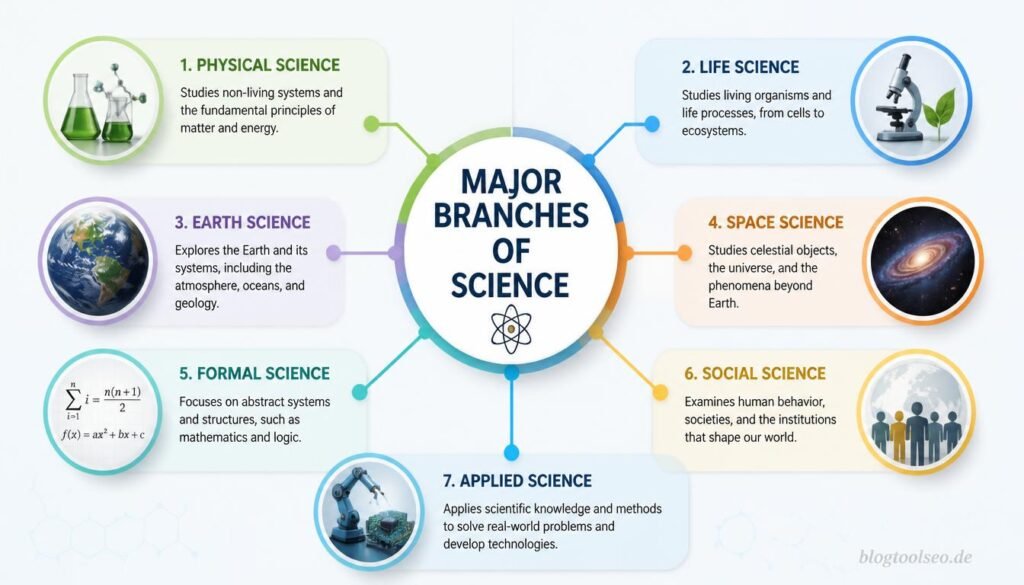
Science contains many interconnected disciplines. Some focus on matter and energy, while others examine living organisms, Earth, societies, information, or human behavior.
Physical Science
Physical science generally focuses on nonliving systems, including matter, energy, motion, forces, chemistry, and physics.
Students may encounter topics such as:
- Atoms and molecules
- Chemical reactions
- Electricity
- Magnetism
- Motion
- Energy
- Waves
- Light
- Forces
A cross-curricular focus on physical science can also connect mathematics, engineering, technology, and practical problem-solving.
Life Science
Life science examines living organisms and biological systems.
It includes subjects such as:
- Biology
- Genetics
- Ecology
- Microbiology
- Zoology
- Botany
- Evolutionary biology
Life science helps explain how organisms function, reproduce, interact, adapt, and respond to their environments.
Earth and Space Science
Earth science investigates our planet and the processes that shape it.
Common areas include:
- Geology
- Meteorology
- Oceanography
- Climate science
- Astronomy
- Earth systems
Students studying earth science may learn about rocks, minerals, weather, oceans, Earth’s structure, natural processes, and the solar system.
Environmental Science
Environmental science studies relationships between natural systems and human activities.
It can involve biology, chemistry, geology, ecology, geography, and atmospheric science.
Topics may include:
- Climate and weather
- Ecosystems
- Water resources
- Air quality
- Soil
- Biodiversity
- Conservation
- Pollution
- Human impacts on natural systems
Because environmental questions often involve several disciplines at once, environmental science is a good example of interdisciplinary research.
What Is Data Science?
Data science combines statistics, computing, mathematics, and domain knowledge to extract useful information from data.
A data scientist might work with large datasets to identify patterns, create models, test hypotheses, or help organizations make evidence-based decisions.
Data science is increasingly connected with:
- Statistics
- Machine learning
- Artificial intelligence
- Programming
- Data visualization
- Database systems
- Business analytics
The field demonstrates how modern scientific thinking increasingly overlaps with computing and mathematics.
What Is Computer Science?
Computer science is the study of computation, algorithms, computer systems, software, and information processing.
Despite its name, computer science is not simply about using computers. It investigates fundamental ideas such as:
- Algorithms
- Programming
- Data structures
- Artificial intelligence
- Computer networks
- Cybersecurity
- Operating systems
- Human-computer interaction
- Computational theory
Computer science also supports research in other scientific fields by providing tools for simulation, data analysis, modeling, and automation.
What Is Forensic Science?
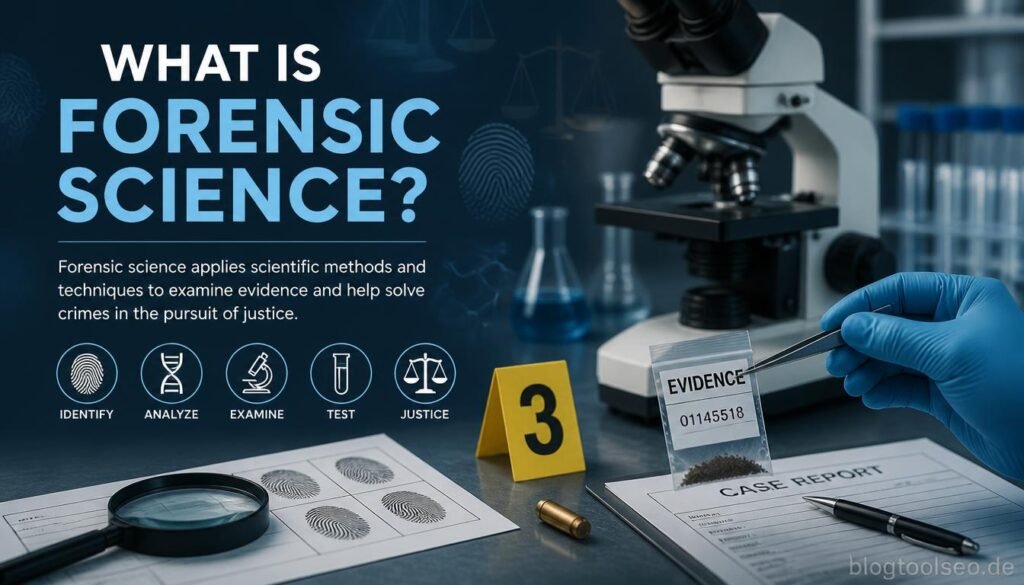
Forensic science applies scientific methods and knowledge to questions related to investigations and the examination of evidence.
Depending on the case, forensic specialists may work in areas such as:
- Biology
- Chemistry
- Toxicology
- Digital evidence
- Materials analysis
- DNA analysis
Forensic science requires careful evidence handling and interpretation. Scientific findings must be distinguished from assumptions or unsupported conclusions.
Is Psychology a Science?
Psychology is commonly considered a behavioral and social science because it uses systematic research methods to investigate behavior and mental processes.
Psychological researchers may use experiments, surveys, observations, statistical analysis, interviews, and other research methods.
However, different areas of psychology use different approaches. For example, experimental psychology may emphasize controlled experiments, while other branches may rely more heavily on observational or correlational research.
The important point is that scientific psychology relies on systematic evidence rather than simply personal opinions about human behavior.
What Is Political Science?
Political science is the systematic study of government, political institutions, political behavior, public policy, international relations, and related social processes.
Instead of being a natural science, it is a social science.
Political science researchers may examine:
- Governments and institutions
- Elections and political participation
- Public policy
- International relations
- Political theory
- Comparative politics
- Political behavior
Because political science studies human societies, researchers may use surveys, statistical analysis, historical research, interviews, case studies, and comparative methods.
Science Education and Learning
Science education is not only about memorizing definitions and formulas. Modern science education increasingly emphasizes investigation, evidence, modeling, data analysis, and explanation.
The National Academies’ K–12 science framework organizes learning around three broad dimensions:
- Scientific and engineering practices
- Crosscutting concepts
- Disciplinary core ideas
The framework encourages students to actively engage with scientific practices rather than only memorize information.
This approach can make science more meaningful because students learn how knowledge is developed as well as what the knowledge says.
Project-Based Inquiry Science
Project-based inquiry science combines scientific investigation with longer-term projects.
Instead of simply answering questions from a textbook, students may investigate a problem, gather evidence, develop explanations, build models, or design solutions.
For example, a class might investigate local water quality, model an ecosystem, study energy use, or design a simple device that addresses a practical problem.
The National Academies highlights investigation and design as important approaches for helping students make sense of natural and engineered systems.
Science Experiments for Students
Science experiments can turn abstract ideas into something students can observe directly.
A useful classroom experiment should have a clear learning objective and appropriate safety precautions. Hands-on activities are most valuable when they are connected to a scientific concept rather than performed simply for entertainment. Research on science education has emphasized the importance of connecting activities with meaningful science content.
Kids Science Experiments at Home
Simple kids science experiments at home can introduce concepts such as density, surface tension, plant growth, forces, and chemical reactions.
Age-appropriate examples include:
- Observing how objects behave when placed in water
- Investigating which materials allow light to pass through
- Growing plants under different ordinary environmental conditions
- Building a simple paper structure and testing its strength
- Observing shadows at different times of day
- Exploring static electricity with safe household materials
Children should perform experiments with suitable adult supervision, especially when an activity involves heat, electricity, glass, chemicals, or anything that could cause injury.
Science News and Discoveries
Science news covers new research, discoveries, scientific debates, technological developments, space missions, medical research, environmental studies, and other developments.
However, not every headline represents a major scientific breakthrough. A responsible reader should look beyond the headline and consider:
- Who conducted the research?
- Where was it published?
- What evidence was collected?
- Was the study peer reviewed?
- How large was the study?
- Are the findings preliminary?
- Have independent researchers obtained similar results?
- Does the headline accurately represent the research?
This habit is particularly important when reading rapidly spreading claims on social media.
Science Fiction and Scientific Ideas
Science fiction uses imagined technologies, scientific concepts, future societies, or speculative discoveries to explore possibilities.
Although fictional stories are not scientific evidence, science fiction can inspire curiosity about real scientific questions.
Common themes include:
- Artificial intelligence
- Space exploration
- Robotics
- Time travel
- Genetic engineering
- Future civilizations
- Planetary exploration
A good science-fiction story may therefore encourage readers to ask genuine questions about science while still remaining a work of fiction.
Science and Health Science bachelor’s degrees
Students interested in science-related careers may encounter degrees such as a Bachelor of Science (BSc) or Bachelor of Health Science.
A Bachelor of Science can cover many subjects, including:
- Biology
- Chemistry
- Physics
- Mathematics
- Computer science
- Environmental science
A Bachelor of Health Science typically focuses more specifically on health-related subjects and may serve as preparation for further study or careers in areas connected with healthcare and health research.
Exact degree structures, admission requirements, and career pathways vary by institution and country, so students should check the official information from the university they are considering.
Science Study Materials and Question Papers
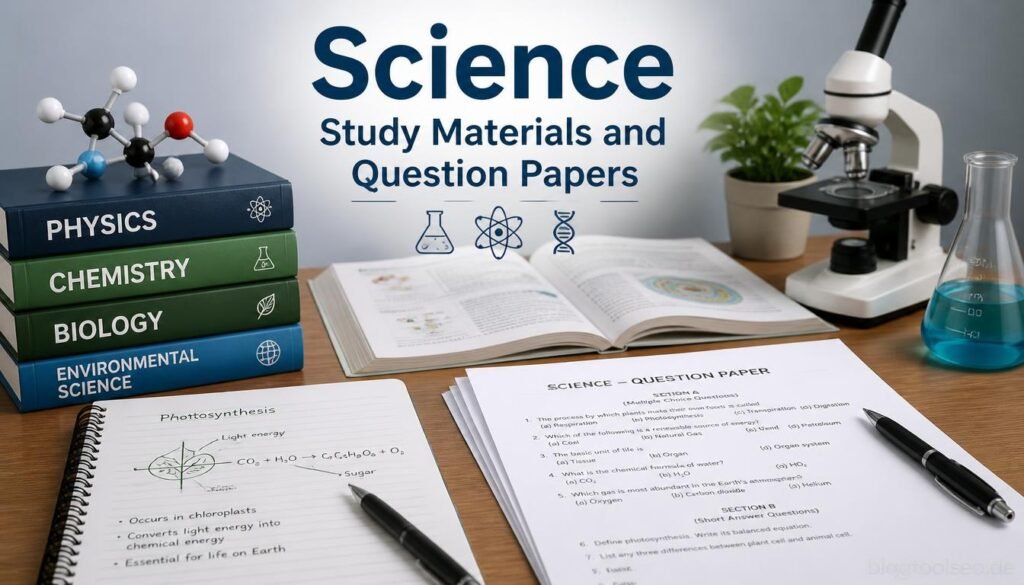
Students frequently search for previous examination papers, notes, journals, practical answers, and subject-specific study material.
Searches such as:
- 6th standard science question paper 2018
- Previous KTET category 3 natural science question papers
- Navneet science journal Std 10 all practical answers 2019 board
- political science optional notes
- MA political science notes in Hindi PDF
- HS political science suggestion 2019
usually reflect a need for exam preparation.
Previous papers can help students understand question formats and practice time management. However, students should use them as study material rather than relying on leaked or unauthorized answers.
Similarly, searches for Edgenuity Earth Science answers are often better approached as requests for help understanding the underlying lesson or solving a problem step by step. Learning the concept is more useful than simply copying an answer.
Science Games and Puzzles
Science can also be learned through games, puzzles, crosswords, quizzes, and interactive activities.
Searches related to ScientificAmerican.com games science crosswords reflect the broader popularity of science-based educational games.
These activities can be useful for reinforcing terminology and concepts, particularly when combined with reading, experiments, and classroom instruction.
Science in Everyday Life
Science is not just found in labs and academic institutions. It manifests itself in daily life.
Cooking involves chemistry and heat transfer. Weather forecasts rely on atmospheric science and data analysis. Smartphones depend on computer science, physics, engineering, and materials science. Medical diagnosis relies on biology, chemistry, statistics, and other scientific disciplines.
Even simple decisions can involve scientific thinking: checking whether evidence is reliable, distinguishing correlation from causation, comparing competing explanations, and recognizing uncertainty.
The National Academies notes that science literacy helps people evaluate scientific information and participate more effectively in discussions involving science and technology.
What Does “Totally Science” Mean?
The phrase totally science can appear in searches, educational discussions, websites, games, or general science-related content.
Its meaning depends on context. It may refer to science-focused learning, educational activities, experiments, or a particular online resource.
When searching for a specific science platform, students should verify that they are using an appropriate and trustworthy educational resource rather than assuming that every website containing the word “science” is authoritative.
Science Garden and Informal Science Learning
A science garden can be used as an informal learning environment where students explore plants, insects, soil, weather, ecosystems, and environmental relationships.
Gardens provide opportunities for observation over time. Students can record plant growth, compare environmental conditions, observe pollinators, or investigate how organisms interact.
This type of learning connects classroom concepts with real-world observations.
Science Museums and Public Learning
Science museums can make scientific ideas accessible through exhibits, demonstrations, historical collections, interactive displays, and educational programs.
People searching for terms such as Fort Worth Museum of Science and History Omni tickets are generally looking for information about visiting a science museum and its associated ticketing options.
Ticket prices, admission policies, exhibitions, and availability can change, so visitors should check the museum’s current official information before planning a visit.
Understanding Science-Related Product Searches
Some searches combine the word science with commercial products or brands. Examples include terms such as Skin Better Science, Peptide Sciences, CV Sciences CBD gummies 10mg Cherry Mango – 30 gummies, and Southwest Science Minimixer 3D Mixer Shaker.
These phrases should not automatically be interpreted as scientific evidence. A product name containing “science” does not establish that a product, ingredient, or claim has been scientifically proven.
When evaluating any health-related or laboratory-related product, readers should distinguish between:
- A brand or product name
- A manufacturer’s claim
- Independent scientific research
- Peer-reviewed evidence
- Regulatory information
- Professional medical or scientific advice
That distinction is an important part of scientific literacy.
Why Science Matters
Science helps society understand complex problems and make decisions using evidence.
Its influence can be seen in:
- Medicine and public health
- Agriculture
- Environmental protection
- Space exploration
- Information technology
- Engineering
- Energy
- Manufacturing
- Education
- Transportation
- Communication
Science also changes over time. New evidence can refine, challenge, or expand existing explanations. That does not mean scientific knowledge is simply a collection of guesses; rather, scientific knowledge develops through evidence, testing, criticism, and continued investigation.
Frequently Asked Questions About Science
What is science in simple words?
Science is a systematic way of learning about the world through observation, evidence, investigation, testing, analysis, and explanation.
What are the main branches of science?
Major areas include physical science, life science, Earth and space science, environmental science, computer science, data science, and social sciences such as psychology and political science.
What is data science?
Data science combines statistics, mathematics, computing, and subject knowledge to analyze data, identify patterns, build models, and generate useful insights.
What is computer science?
Computer science studies computation, algorithms, programming, computer systems, information processing, and related areas such as artificial intelligence.
Is psychology a science?
Psychology is generally classified as a behavioral and social science. Many areas of psychology use systematic research, experiments, observations, surveys, and statistical analysis.
What is forensic science?
Forensic science applies scientific knowledge and methods to the examination and interpretation of evidence relevant to investigations.
What is environmental science?
Environmental science is an interdisciplinary field that studies Earth’s environmental systems and the relationships between organisms, natural processes, and human activities.
What is political science?
Political science is the systematic study of government, political institutions, political behavior, public policy, and international relations.
What are good kids science experiments at home?
Age-appropriate activities can explore concepts such as density, light, plant growth, static electricity, forces, and materials. Experiments should be selected according to the child’s age and performed with appropriate adult supervision.
What is project-based inquiry science?
Project-based inquiry science uses questions, investigation, evidence, and longer-term projects to help students develop scientific understanding and problem-solving skills.
What is physical science?
Physical science generally focuses on matter, energy, forces, motion, chemistry, physics, and other nonliving physical systems.
What is a Bachelor of Science?
A Bachelor of Science is an undergraduate degree that can cover many scientific and technical disciplines, including biology, chemistry, physics, mathematics, computer science, and environmental science.
What is a Bachelor of Health Science?
A Bachelor of Health Science is an undergraduate degree focused on health-related scientific and applied subjects. Its structure and career pathways vary between institutions.
Why are science experiments important?
Experiments allow learners to investigate questions, collect evidence, observe outcomes, and connect scientific concepts with real-world phenomena.
Why is science news important?
Science news helps people follow new research and discoveries, but readers should examine the original research and reliable sources rather than relying solely on headlines.
What is science fiction?
Science fiction is a form of fiction that explores imagined scientific ideas, technologies, future societies, or speculative possibilities.
Can previous science question papers help students?
Yes. Previous papers can help students become familiar with question formats, identify topics for revision, and practice answering questions under time limits.
Where can students find science study notes?
Students can use textbooks, school materials, university resources, reputable educational websites, teacher-provided notes, libraries, and official examination resources.
Are product claims containing the word “science” automatically scientifically proven?
No. A product name or marketing phrase is not scientific evidence. Claims should be evaluated using reliable research and appropriate expert or regulatory information.
Final Thoughts
Science is much bigger than a school subject. It is a structured approach to understanding the world, evaluating evidence, testing explanations, and improving knowledge.
Whether someone is exploring data science, studying computer science, preparing for an Earth science examination, conducting kids science experiments at home, considering a Bachelor of Science, researching environmental science, or simply reading the latest science news, the same principle remains important: ask questions, examine evidence, and remain willing to revise an explanation when better evidence becomes available.
Modern science education increasingly encourages students to participate in investigation, analyze information, develop explanations, and connect ideas across disciplines.
That mindset is useful far beyond the classroom. It helps people understand technology, evaluate claims, interpret information, and make more informed decisions in a world increasingly shaped by scientific and technological developments.