Search engine optimization has always been a discipline built on tools. No single person can manually track thousands of keywords, crawl a website page by page, or monitor backlinks across the entire web. SEO tools exist to close that gap — to turn raw search data into decisions you can actually act on.
This guide explains what SEO tools are, how they’re categorized, and which specific tools and tool types are worth your attention right now — including platforms for YouTube, Etsy, technical audits, indexing verification, and the newer category of tools built to track visibility inside AI-generated answers rather than traditional search results.
What Are SEO Tools?
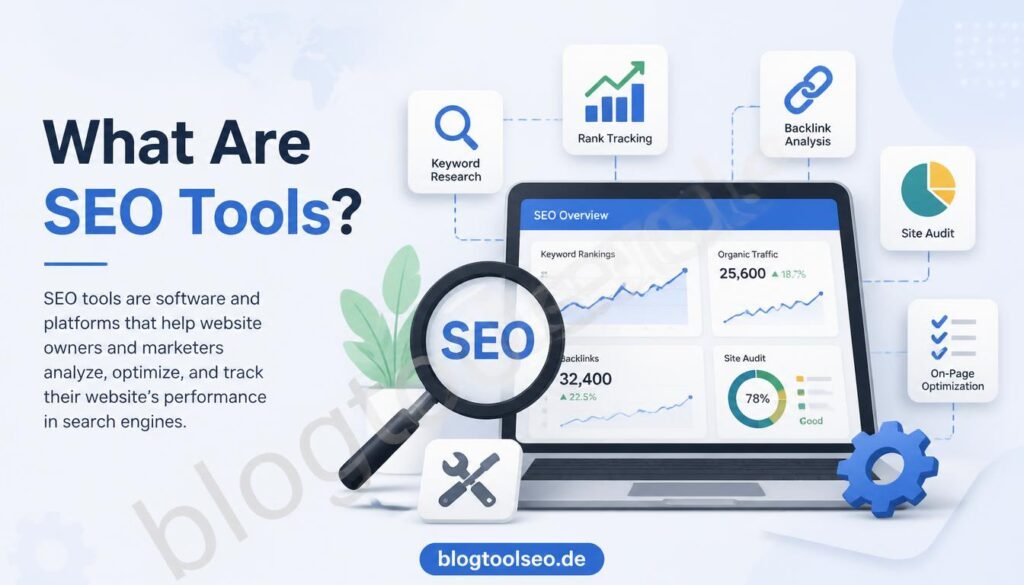
SEO tools are software applications designed to support one or more stages of search engine optimization: researching what people search for, diagnosing why a website isn’t ranking, tracking competitors, measuring performance, and producing content that satisfies both readers and ranking algorithms.
Put simply, an SEO tool answers one of the following questions:
- What are people searching for, and how often?
- Why isn’t a specific page ranking as expected?
- What is a competitor doing differently, and is it working?
- Has a page actually been indexed and crawled correctly?
- Is a given piece of content structured well enough for search engines — and increasingly, for AI systems — to understand and surface it?
- Is the overall SEO strategy producing measurable traffic and conversions over time?
Understanding which question a tool answers is the fastest way to evaluate whether you actually need it, rather than collecting tools because they’re popular.
The Core Categories of SEO Tools
Most SEO tools fall into one of six functional categories:
1. Keyword research tools. These estimate search volume, competition, and intent behind specific queries. Ahrefs Keyword Explorer, SEMrush Keyword Magic Tool, and Google Keyword Planner are a few examples.
2. Technical audit and crawling tools. These simulate how a search engine bot crawls a site, flagging broken links, duplicate metadata, redirect chains, and indexing obstacles. This is the category most professionals mean when they refer to an “SEO frog tool” — a reference to Screaming Frog SEO Spider, one of the most widely used desktop crawlers in the industry.
3. Rank tracking and analytics tools. These monitor keyword position over time and connect that movement to actual traffic and conversions.
4. Backlink analysis tools. These map who links to a site, evaluate the authority of those links, and surface link-building opportunities based on competitor backlink profiles.
5. Content optimization tools. These assist with writing, structuring, and scoring content against what’s currently ranking — increasingly including tools built for non-English markets, such as German-language SEO writing platforms.
6. Indexing and AI-visibility tools. A newer category covering two related needs: confirming that content has actually been indexed by traditional search engines, and — more recently — checking whether content is being surfaced or cited by large language models such as ChatGPT, Gemini, and Perplexity.
Very few teams use one platform that covers all six categories equally well. Most professional SEO workflows combine two to four specialized tools rather than relying on a single “all-in-one” suite.
Best YouTube SEO Tools
YouTube functions as a search engine in its own right — the second-largest by query volume globally — and it ranks video content based on a mix of keyword relevance, click-through rate, watch time, and audience retention. Because of that, YouTube SEO tools tend to combine keyword data with performance analytics rather than focusing on keywords alone.
The most consistently recommended tools in this category include:
- TubeBuddy — a browser extension offering tag suggestions, thumbnail A/B testing, and best-time-to-publish recommendations.
- vidIQ — similar in function to TubeBuddy, with strong competitor-channel benchmarking features.
- Google Trends — free, and useful for identifying rising topics before they become saturated.
- YouTube Studio Analytics — YouTube’s own native analytics dashboard, which provides audience retention data more accurately than any third-party tool, since it draws directly from platform data.
A practical workflow for creators is to use a free keyword tool to identify topic opportunities, then rely on YouTube Studio’s native retention graphs to refine which parts of a video are keeping (or losing) viewers.
Free SEO Tools for YouTube and General Use
Budget constraints are real, particularly for solo creators, freelancers, and early-stage businesses. Several free tools deliver genuine value:
- Google Keyword Planner — originally built for advertisers, but usable for estimating organic search volume.
- AnswerThePublic (free tier) — useful for surfacing question-based content ideas, which also tend to perform well in voice search and AI-generated answers.
- Ubersuggest (free tier) — limited daily queries, but reliable for quick keyword checks.
- YouTube and Google autocomplete — free, real-time signals of exactly how people phrase their searches.
The limitation of free tools is almost always depth and historical tracking, not accuracy. They’re well suited to research and ideation, but weaker for long-term monitoring — which is typically where a paid subscription becomes worth the cost.
Etsy SEO Tools
Etsy operates its own internal search algorithm, which behaves more like Amazon’s marketplace search than Google’s web search. Etsy-specific SEO tools — most notably eRank and Marmalead — analyze listing titles, tags, and categories against real buyer search behavior on the platform itself.
The underlying principle is identical to any other form of SEO: match your titles and tags to the exact language buyers use, rather than language that sounds professional to the seller. What makes Etsy SEO tools necessary is that general-purpose SEO platforms don’t have access to Etsy’s internal search data — a gap these specialized tools are built to fill.
Group Buy SEO Tools: What They Are and What to Consider
Group buy SEO tools refer to shared access to premium platforms — such as Ahrefs, SEMrush, or Moz — split across multiple users to reduce individual cost. Given that premium SEO suites can cost several hundred dollars per month, group buy access has become a common workaround for freelancers, students, and small agencies operating on limited budgets.
The benefit is straightforward: significantly lower cost for access to enterprise-level data.
The trade-offs are equally important to weigh:
- Shared account limitations — usage caps, shared project history, and no guarantee of consistent uptime.
- No official support — group buy access typically violates the platform’s terms of service, meaning there’s no recourse if access is revoked.
- Data privacy concerns — shared accounts mean your research history is visible to other users of the same login.
For casual, exploratory research, the risk may be acceptable. For client-facing or business-critical SEO work, budgeting for a legitimate subscription — or choosing one of the many lower-cost tools built specifically to compete on price — is generally the more sustainable choice.
Rapid Index Checkers: Confirming Your Pages Are Actually Indexed
A rapid index checker is a tool built for one specific purpose: confirming, quickly and often in bulk, whether a URL has been indexed by a search engine. This distinction matters because a page can be well-optimized and still generate zero organic traffic if it hasn’t been indexed yet.
These tools typically work by querying search engines directly or cross-referencing indexing APIs, and they’re most useful in three scenarios:
- After a site migration, to confirm new URLs have replaced old ones in the index.
- After bulk content publishing, to verify large batches of pages have been crawled.
- After a link-building campaign, to confirm that backlinks placed on external domains have actually been indexed and are passing value.
For your own website, Google Search Console remains the most authoritative source of indexing data. Third-party rapid index checkers become more valuable when verifying URLs you don’t control directly, such as guest posts or placed backlinks.
Screaming Frog and Other Technical Crawling Tools
The tool most professionals refer to when discussing a desktop “frog” crawler is Screaming Frog SEO Spider. It crawls a website the way a search engine bot would, surfacing technical issues such as broken links, duplicate title tags, missing meta descriptions, redirect chains, and crawl depth problems — all in a single scan.
Its value comes from delivering raw, unfiltered crawl data rather than a simplified dashboard interpretation, which gives experienced SEOs the granularity needed to diagnose issues precisely. For any site with more than a handful of pages, running a full technical crawl on a quarterly basis is a reasonable minimum to catch problems before they affect rankings.
Best LLM SEO Checking Tools
This is the fastest-growing category in the SEO tools landscape, driven by a real shift in how people search. A growing share of queries are now answered directly inside AI systems — ChatGPT, Gemini, Perplexity, and Google’s AI Overviews — rather than through a traditional list of ranked links. This has created demand for tools that measure and improve visibility inside those AI-generated answers, sometimes called LLM SEO, Generative Engine Optimization (GEO), or AI search optimization.
The best LLM SEO checking tools generally perform one or both of the following functions:
- Prompt testing — running a set of representative queries across multiple AI models to check whether, and how, a brand, product, or piece of content is referenced in the response.
- Content structure analysis — evaluating whether a page is written in a way that large language models tend to favor when summarizing a topic, including clear headers, direct answers near the top of sections, well-defined terminology, and factual density over marketing language.
Because this space is still developing and no single model discloses its ranking or citation logic publicly, any tool’s “LLM visibility score” should be treated as a directional signal rather than a definitive measurement. That said, the underlying content practices these tools reward — clarity, structure, and directly answering the question a reader is asking — align closely with good traditional SEO writing, meaning that improving one often improves the other.
Other Notable SEO Platforms Worth Knowing
Several additional platforms come up frequently in professional SEO discussions:
- XOVI — a German-origin, all-in-one SEO suite widely used in European markets, combining rank tracking, backlink analysis, and technical site audits within a single dashboard.
- SEO Nest — a lighter-weight platform aimed at small businesses and agencies that want core rank tracking and reporting features without the cost or complexity of larger enterprise suites.
- Sumo — primarily known for on-site conversion tools such as pop-ups, email capture, and list-building widgets. It isn’t a full SEO platform, but its traffic capture features make it a useful companion to a broader SEO stack.
- SEO Texte Schreiben tools — a category of AI-assisted content writing platforms built specifically for producing German-language SEO copy. These matter because keyword density, compound word structures, and search intent patterns in German do not translate directly from English-language writing tools, making a language-specific tool meaningfully more effective for that market.
Building a Practical SEO Tool Stack
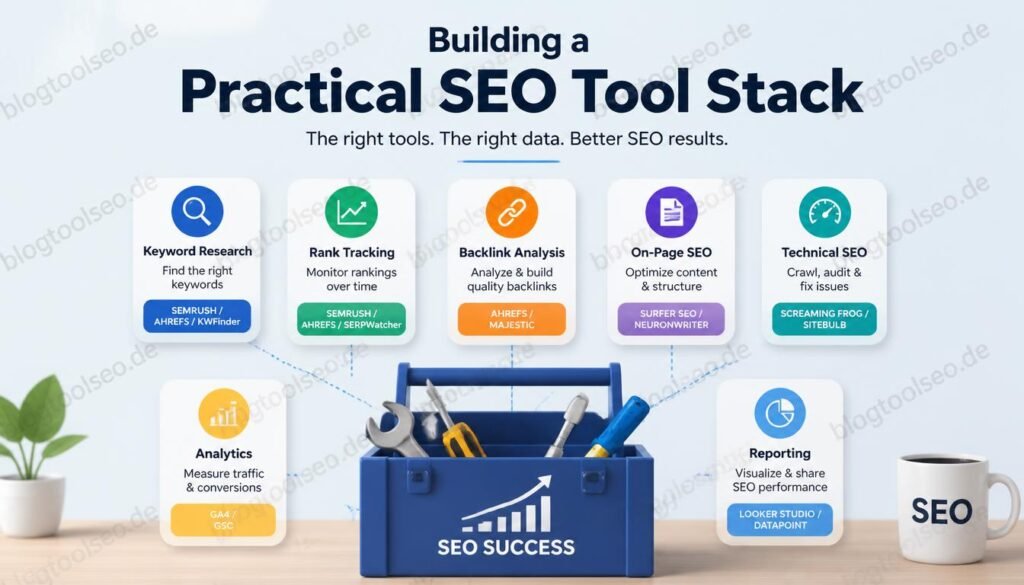
A realistic, professional starting stack looks like this:
- One keyword research tool — a free tier is a reasonable starting point.
- One technical crawler — for periodic full-site audits.
- One rank tracker — to measure whether optimization efforts are actually producing movement.
- One content optimization tool — particularly if content is being produced at scale or in multiple languages.
- One indexing verification method — Google Search Console at minimum, supplemented by a rapid index checker for external URLs when needed.
- One AI visibility check — as a growing share of search shifts toward AI-generated answers, monitoring how content performs in that environment is becoming a standard part of a modern SEO process rather than an optional extra.
The most common mistake in SEO tooling isn’t choosing the wrong tool — it’s accumulating five or six tools and using none of them consistently. A smaller stack, used regularly and reviewed monthly, consistently outperforms a larger stack that’s checked once and forgotten.
Frequently Asked Questions
What are SEO tools used for? SEO tools are used to research keywords, audit websites for technical issues, track search rankings, analyze backlinks, optimize content, and verify that pages have been properly indexed by search engines and, increasingly, referenced by AI systems.
Do I need paid SEO tools, or are free tools enough? Free tools are sufficient for early-stage research and occasional checks. Paid tools become worthwhile once ongoing tracking, competitor analysis, or client reporting is required, since free tiers typically limit query volume and historical data.
Is Screaming Frog the same as an “SEO frog tool”? Yes — “SEO frog tool” is a common informal reference to Screaming Frog SEO Spider, a desktop crawler used for technical site audits.
What is a rapid index checker used for? It confirms whether specific URLs — often backlinks placed on external sites — have been indexed by a search engine, which is useful for verifying that link-building or content publishing efforts are actually taking effect.
Are group buy SEO tools safe to use? They carry real risks, including account instability, lack of official support, and shared data visibility. They may be acceptable for informal research but are generally not recommended for client work or business-critical decisions.
How do LLM SEO checking tools differ from traditional SEO tools? Traditional SEO tools measure visibility in search engine results pages. LLM SEO tools measure whether and how content is referenced inside AI-generated answers, which depends more heavily on content clarity, structure, and directness than on traditional ranking signals like backlinks.
Final Thoughts
SEO tools remove guesswork from a process that would otherwise rely entirely on intuition. They show what’s actually being searched, what’s technically broken on a site, and — increasingly — whether content is visible not just to search engines, but to the AI systems now standing between users and the web. The tools themselves are only as valuable as the consistency with which they’re used. Choosing a focused, purpose-built stack and reviewing it regularly will outperform any single all-in-one platform used sporadically.